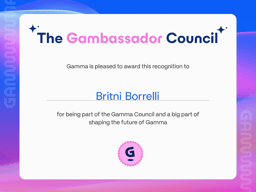
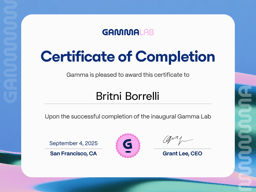
YAY!!!! I love that we get the alert early! Let's go! Congrats on the next launch and best wishes to a strong announcement tomorrow!!
Nikolas P. Hi! Yes I do have a brand kit I'm trying to emulate. See photo. I'd like choices of colors for different styling choices. I dont have enough choices to make the purple gradient which i believe would close out the brand kit.
Does anyone have a "template" for building Templates in Gamma? ha Or a template or three they'd be willing to share with me so i can copy the prompts or have an idea of what works? I don't really know where to begin or what style of templates i should create as my brain doesn't function in code.
It would be great to have more options to add colors for themes. Or where I can have both a solid and gradient version of the same version (which is what I was trying to do), but then any other accent colors I want to add outside of our specific branding, I can't add as I'm maxed out. ◡̈
I’d like to suggest an update to how Tips & Tricks are surfaced in Gamma. Right now, the first-time login flow shows a static version which quickly gets buried at the very end of Gamma creations. This means many users never see the new updates that could help them, and many new ones don't get presented to users easily. The Ask: Can we replace the static onboarding version with the newest version of Tips & Tricks, have a label "updated on..." on the very first card, and also surface it in a more visible location (for example, earlier in the flow or as a clearly noticeable tile/section when logging in)? Why It Matters:
Immediate Value Delivery: Long-time users get the freshest, most useful tips consistently, which increases their chance of adoption success.
Adoption & Retention: When people see quick wins, they’re more likely to keep using Gamma and explore further.
Feature Awareness: New functionality often goes unnoticed unless it's an accident or intentionally following the team. Elevating visibility ensures our best work doesn’t stay hidden.
Reduced Support Load: Clear, updated guidance helps users self-serve instead of opening tickets or getting frustrated.
This change is a relatively small adjustment but has a high return, it makes sure every new user has the best possible first experience with Gamma. Thanks for considering this, happy to brainstorm placement ideas if helpful.
Another Ask: Could Gamma build a way for enterprises to enforce narrative rules when creating decks, almost like “guardrails” that ensure every presentation follows strategic storytelling patterns (e.g., always leading with outcomes, framing pain a certain way, avoiding feature wars, positioning the category correctly)? Why it’s valuable: • In every enterprise, the moment you hand a sales team a “standard deck,” they immediately tailor it back to their comfort zone… old slides, familiar talk tracks, feature-heavy content. This dilutes strategy and undermines alignment. • CROs and strategy leaders spend countless hours trying to re-train reps to focus on outcomes, not features. But without structural guardrails, the problem repeats every quarter. • If Gamma could “bake in” enterprise-level storytelling frameworks (pain → outcome → value → vision), every rep would be nudged to stay inside the right narrative without needing a police squad of enablement managers. • This shifts Gamma from being “a beautiful deck builder” to being a strategy enforcer at scale. It ensures the story the enterprise wants to tell is the story actually hitting the market. Why now: In a world where every competitor can copy your features in months, narrative control is the only true differentiator. Gamma is perfectly positioned to operationalize this, not just helping people make slides, but ensuring every slide reinforces the enterprise’s strategic storyline. I would be VERY interested in this and could get Gamma signed across my new company in a heartbeat.
Here are a few of my ideas… A live, automatically updating deal room - one beautiful, concise hub where buyers and sellers can access content, agreements, and daily updates in real time. Think Google Docs, but if it went to business school, stopped wearing hoodies, and finally learned how to keep both parties honest. Gamma’s superpower today is turning messy, static content into dynamic stories people actually want to engage with. A deal room is just the next logical step: instead of one Gamma deck, imagine a living Gamma hub … the same design-forward, story-driven experience, but applied to the entire deal journey. Why it’s not so far off: • Gamma already nails clarity of narrative. A deal room is simply multiple Gamma “chapters” strung together - proposal, ROI calculator, integration plan, mutual plan - all in one place. • Gamma already supports interactivity (branching, embeds, navigation). A deal room just leans into that, letting both sides choose their path (high-level skim vs. deep dive). • Gamma already helps people communicate better, faster. A deal room takes that same principle and applies it to a relationship instead of a single presentation. So instead of thinking of it as “CRM creep,” it’s more like Gamma stepping into persistent storytelling - helping people not just pitch an idea, but live inside the same narrative until the deal is done. A choose-your-own-adventure storytelling mode - perfect for investor decks or enterprise pitches. Let decision-makers skim the straightforward essentials or dive into the weeds if they’re curious. No more “one deck to bore them all.” Instead, it’s the business version of Netflix: you pick your path, but the ending still gets you to a yes. Why it fits Gamma’s DNA: • Gamma already makes presentations feel less like static walls of text and more like narratives people want to move through. A branching, choose-your-own-adventure format is just a natural evolution - the story can adapt to the audience. • Interactivity is baked into Gamma’s design philosophy (tiles, navigation, AI-assisted structure). This feature would double down on Gamma’s strength: letting the audience guide the flow without losing the storyline. • Gamma’s big differentiator is turning complexity into clarity. Some stakeholders want “just give me the TL;DR,” while others crave details. A deck that flexes for both = clarity at scale. Why it would be valuable: • Investor decks: Investors are notorious for flipping past slides until they hit “the money slide.” With branching decks, they could choose a “quick skim path” or a “deep dive path,” while you still control the narrative. • Enterprise sales: Execs want outcomes. Technical evaluators want integration details. Instead of building 5 versions of the same deck, one Gamma deck could flex to each audience. • Teaching & enablement: Learners with different levels of knowledge can self-direct - keeping everyone engaged instead of tuned out. This feature makes Gamma decks dynamic conversations instead of one-way broadcasts. That’s not just on brand… that’s Gamma fully leaning into what makes it special.
.png)